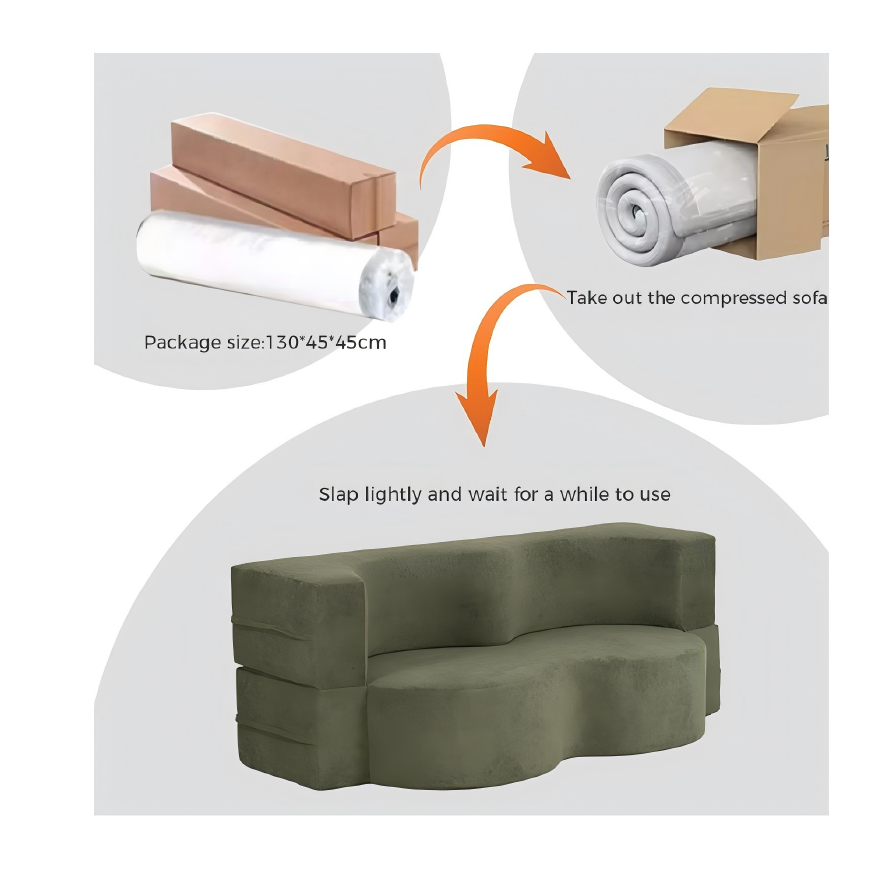
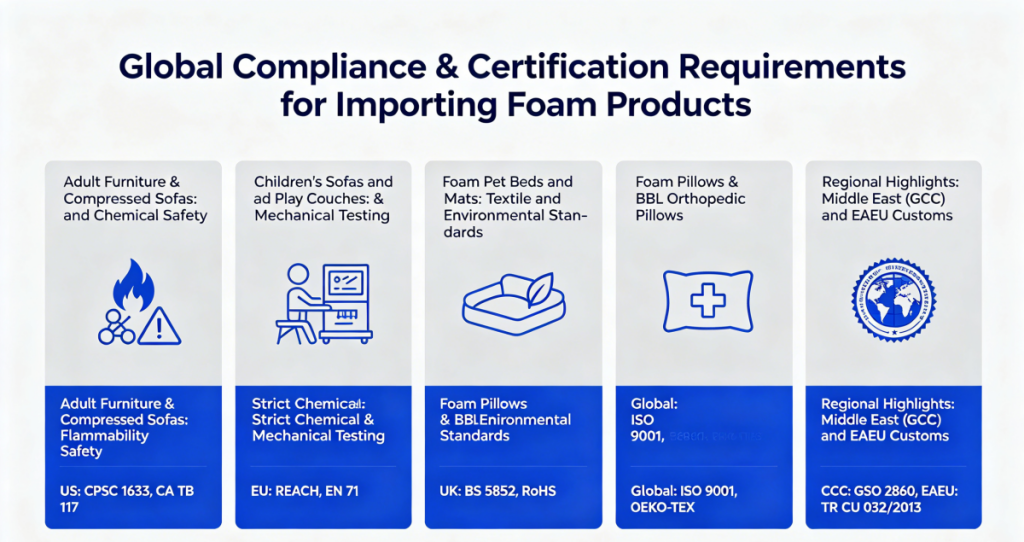
As a global sourcing manager or e-commerce distributor, importing compressed foam furniture, children’s sofas, pet beds, and orthopedic pillows can be highly lucrative. Vacuum compression technology has revolutionized logistics by slashing ocean freight costs. However, many importers face a hidden, costly bottleneck at customs: regulatory compliance.
Failing to provide the exact chemical safety or flammability certificates required by your target market can lead to seized shipments, heavy fines, or forced product recalls.
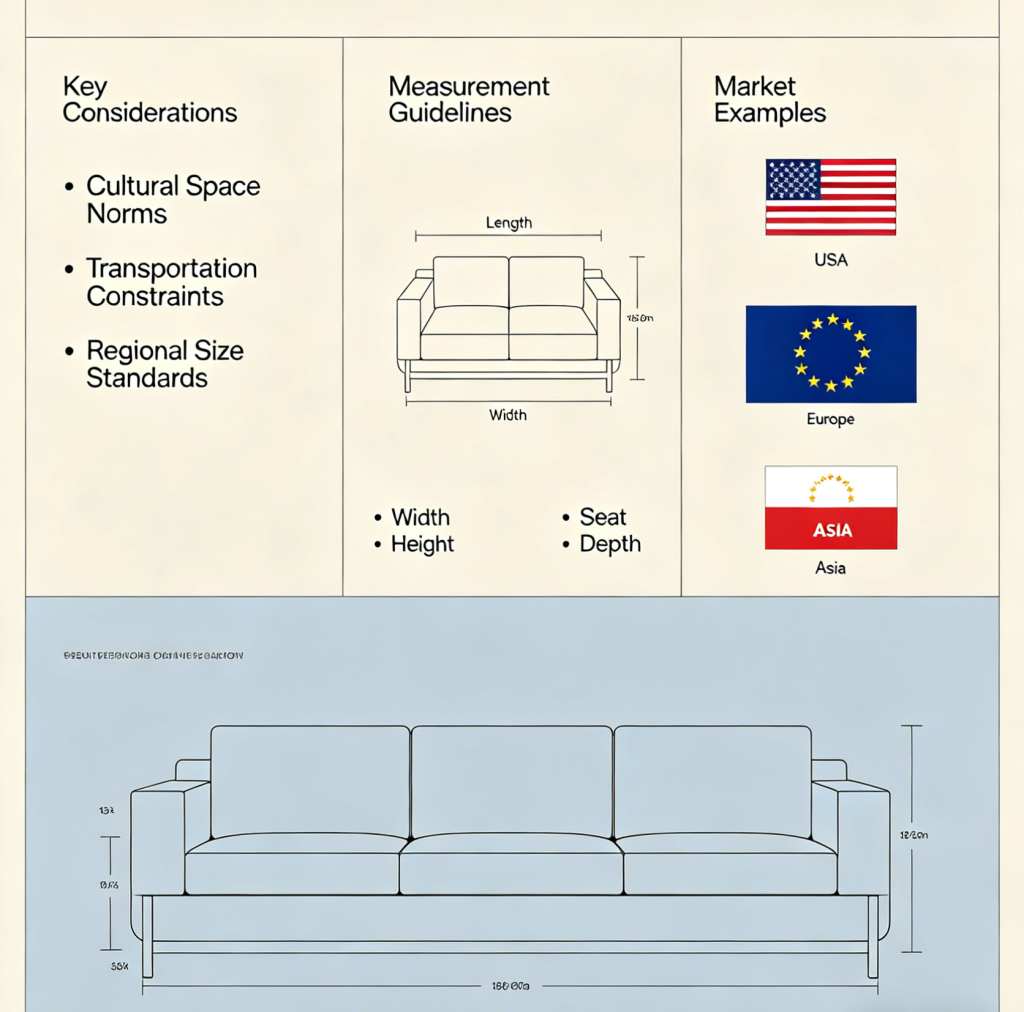
This comprehensive guide breaks down the essential global compliance and certification requirements for importing foam products into the US, Europe, the UK, the Middle East (GCC), and the EAEU (Russia/Kazakhstan).
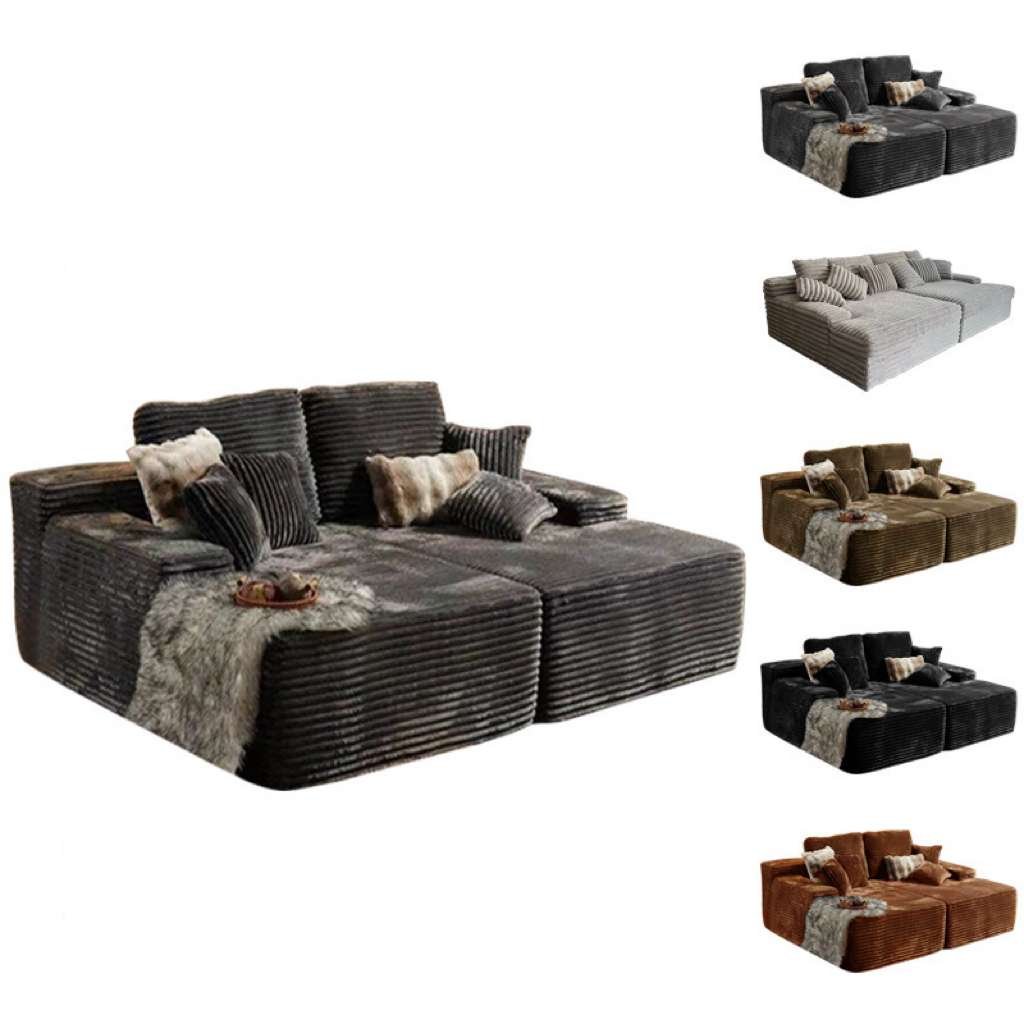
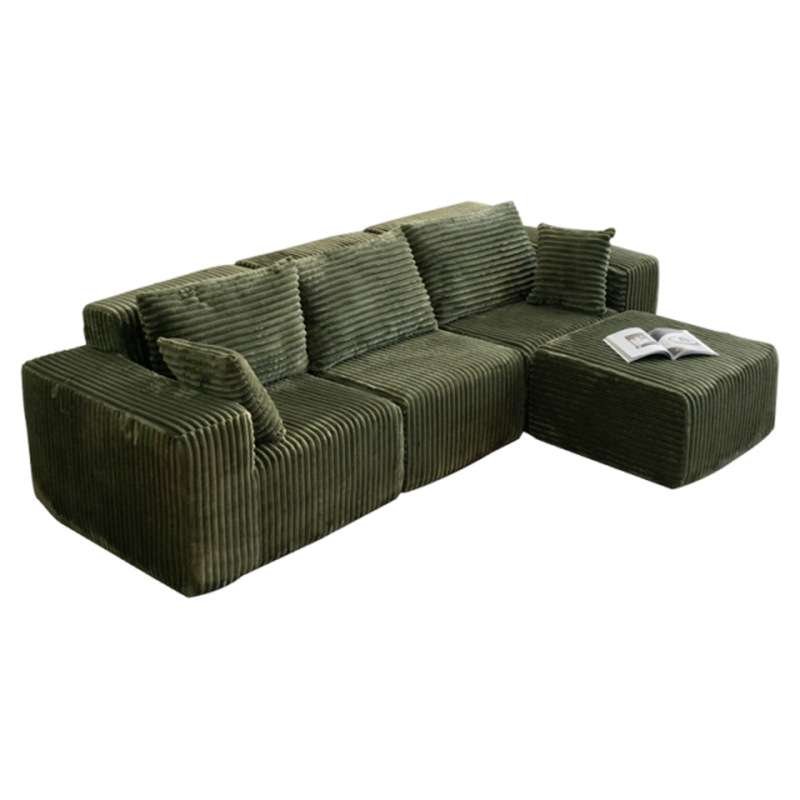
1. Adult Furniture & Compressed Sofas: Flammability and Chemical Safety
When importing adult compressed sofas or living room furniture, customs and local market authorities focus on two primary risks: how easily the foam catches fire and whether the chemical flame retardants used are toxic.
United States Market
TB117-2013 (California Technical Bulletin 117): This is the gold standard for upholstered furniture in the US. It regulates the smolder resistance of cover fabrics and polyurethane foam fill. Your manufacturer must provide a compliance label sewn into the sofa.
TSCA Title VI (Formaldehyde Standards): If your compressed sofa incorporates any engineered wood components (like internal frames or bases), the wood must be certified compliant with TSCA Title VI regarding formaldehyde emissions.
European Union Market
REACH Regulation (EC 1907/2006): Unlike the US, the EU heavily prioritizes chemical safety over heavy flame-retardant usage. Your foam sofas must be tested to ensure harmful Substances of Very High Concern (SVHCs)—such as heavy metals, certain phthalates, and banned azo dyes—fall below 0.1% by weight.
EN 1021-1 & EN 1021-2: These European standards test the ignition resistance of upholstered furniture against a smoldering cigarette (-1) and a match flame equivalent (-2).
United Kingdom Market
UK Furniture and Furnishings (Fire) (Safety) Regulations 1988: The UK has some of the strictest fire safety laws in the world. An EU certificate is not enough for the UK. Foam fillings must pass the stringent BS 5852 flammability test using specific “Crib 5” ignition sources. Products must feature the appropriate UK safety display labels.
2. Children’s Sofas and Play Couches: Strict Chemical & Mechanical Testing
Children’s furniture, such as 3-in-1 convertible play couches and flip-out sofas, is categorized under high-risk consumer goods. Authorities assume toddlers will have direct, prolonged skin contact (and occasional oral contact) with these products.
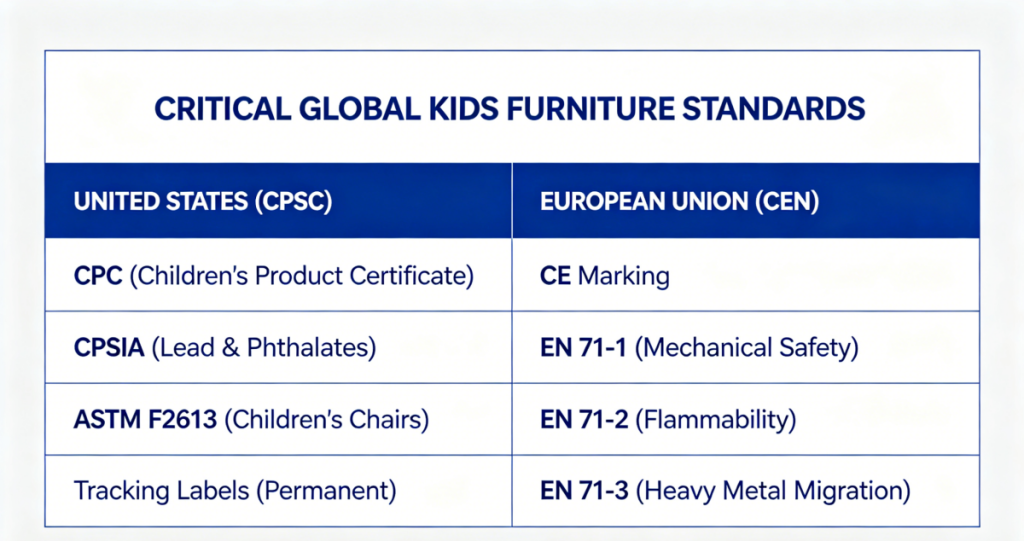
United States (CPSC Requirements)
CPSIA (Consumer Product Safety Improvement Act): Requires rigorous third-party laboratory testing for lead content (in zippers, fabrics, and inks) and restricted phthalates (plasticizers used in waterproof coatings) to ensure they are under 100 ppm.
ASTM F2613: The specific standard for children’s chairs and stools, testing for structural stability, entrapment hazards, and sharp edges.
CPC (Children’s Product Certificate): The importer of record must issue a CPC based on passing test scores from a CPSC-accepted lab.
Tracking Labels: Children’s products must feature a permanent tracking label on the product and packaging, detailing the manufacturer name, location, production date, and batch number.
European Union & UK Requirements
EN 71 Series (Toy Safety Directive): Even though it is furniture, convertible play sofas often fall under toy regulations if they have a play value.
EN 71-1: Mechanical and physical properties (no choking hazards or small parts like loose zipper pulls).
EN 71-2: Flammability (ensures flame spread speed gives children time to escape).
EN 71-3: Migration of certain elements (tests for 19 heavy metals in the foam and fabric).
CE & UKCA Marking: The product must bear the CE mark (for Europe) or UKCA mark (for Great Britain) to prove compliance.
3. Foam Pet Beds and Mats: Textile and Environmental Standards
While pet accessories face fewer mandatory government certifications than children’s goods, importing high-density foam pet beds or orthopedic dog mats requires commercial certifications to clear customs smoothly and satisfy retailer demands.
Global Market Expectations
OEKO-TEX® Standard 100: This is the most sought-after textile credential for pet products. It guarantees that the outer fabric cover (velvet, linen, or oxford cloth) has been tested for harmful chemicals and is completely safe for animals to sleep and chew on.
CertiPUR-US® / CertiPUR-EU®: If you are importing memory foam or high-density polyurethane foam pet beds, having a CertiPUR certification proves the foam is made without ozone depleters, mercury, formaldehyde, or regulated phthalates, and features low VOC (Volatile Organic Compound) emissions for indoor air quality.
Customs Classification Tip: Ensure your freight forwarder classifies pet beds correctly under textile/bedding HS codes rather than general plastic/foam categories to avoid unexpected tariff penalties.
4. Foam Pillows & BBL (Brazilian Butt Lift) Orthopedic Pillows
Foam pillows, memory foam contour pillows, and specialized recovery items like BBL (Brazilian Butt Lift) wedge pillows straddle the line between home bedding and medical wellness devices.
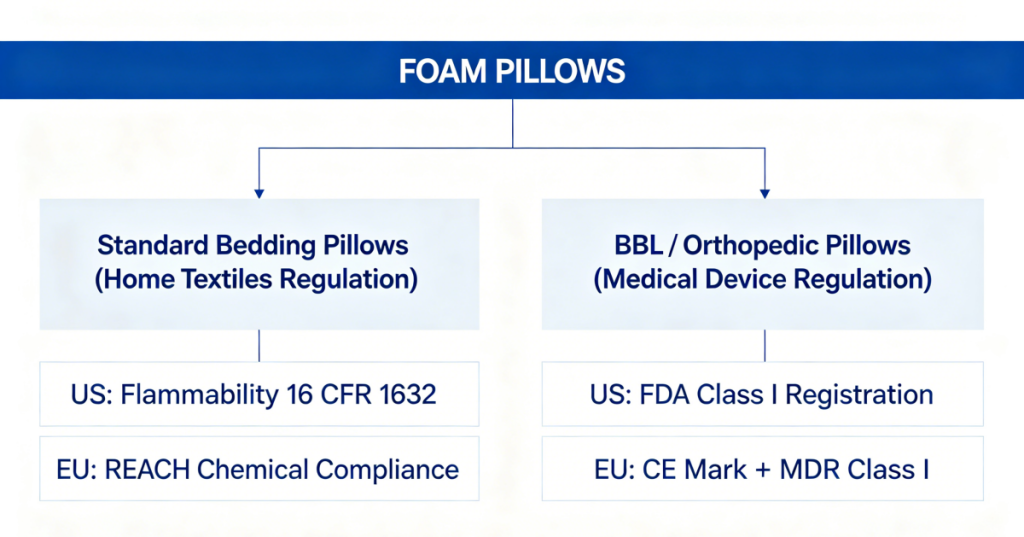
Standard Bedding Pillows
United States: Must comply with 16 CFR Part 1632 (Standard for the Flammability of Mattresses and Mattress Pads) if categorized as sleep bedding, along with law tags specifying the filling materials.
Europe: Regulated primarily under general textile laws and REACH to ensure skin-contact fabrics are non-toxic.
BBL & Orthopedic Wedges (The Medical Device Catch)
If your marketing copy, packaging, or listing descriptions state that the pillow “accelerates post-surgery healing,” “relieves medical sciatica,” or is designed specifically for “post-BBL recovery,” it may trigger medical device enforcement.
United States (FDA Class I): Orthopedic and surgical pillows are considered Class I Medical Devices. Importers must ensure the manufacturing factory is registered with the FDA, and the importer must complete an FDA medical device listing before commercial entry.
European Union (MDR 2017/745): Under the Medical Device Regulation, medical support pillows require a Class I CE Mark Declaration of Conformity, technical documentation file maintenance, and a designated European Authorized Representative (Ear) if the importer is outside the EU.
5. Regional Highlights: Middle East (GCC) and EAEU Customs
If you are expanding your foam import operations beyond the US and Europe into the Gulf states or Eastern Europe, keep these strict regional frameworks in mind:
The Gulf Cooperation Council (UAE, Saudi Arabia, etc.)
SABER Platform & SASO (Saudi Arabia): For Saudi Arabia, all foam furniture and kids’ products must be registered on the SABER online portal. High-risk items require a Product Certificate of Conformity (PCoC) and a Shipment Certificate of Conformity (SCoC) verified by an approved certification body.
Gulf Conformity Mark (G-Mark): Children’s toys and children’s convertible foam furniture imported into GCC member states must bear the G-Mark, requiring third-party testing for safety and flammability.
The Eurasian Economic Union (EAEU – Russia, Kazakhstan, Belarus)
EAC Certification / Declaration: Furniture and children’s goods entering the EAEU must comply with Technical Regulations (TR CU 025/2012 for furniture safety and TR CU 007/2011 for children’s product safety). Testing must be conducted by an accredited laboratory within the EAEU customs union to obtain the mandatory EAC stamp.
Summary Checklist for Foam Importers
Before wiring your deposit payment to a foam manufacturer, execute this verification checklist to guarantee a smooth import process:
Audit Factory Certificates: Ask the factory for recent test reports (under 1 year old) from accredited third-party testing agencies like SGS, TÜV, Intertek, or Bureau Veritas.
Review Product Copy: Carefully choose whether to market orthopedic pillows as “comfort accessories” or “medical recovery aids” to manage your FDA/MDR exposure.
Confirm Law Labels & Branding: Ensure your supplier can apply permanent tracking labels for kids’ sofas (CPSIA) or flammability tags for adult furniture (TB117 / BS5852) directly at the assembly line.
Account for Vacuum Expansion: Verify with your manufacturer that their high-density foam (35D–45D) holds valid CertiPUR or OEKO-TEX credentials, ensuring the foam safely recovers its structural integrity after months of vacuum sea-freight compression without off-gassing harmful chemicals.