
Part 1: Compressed vs. Traditional Sofas — The Logistics Breakthrough
To appreciate why compressed sofas are dominating the e-commerce landscape, it helps to analyze how they compare to traditional, fully assembled upholstered furniture in terms of transport economics.
Maximizing Container Yields
Traditional sofas are shipped fully assembled or semi-knocked-down (SKD). Because they occupy massive amounts of space relative to their weight, you end up paying to ship “empty air,” resulting in highly inefficient freight costs.
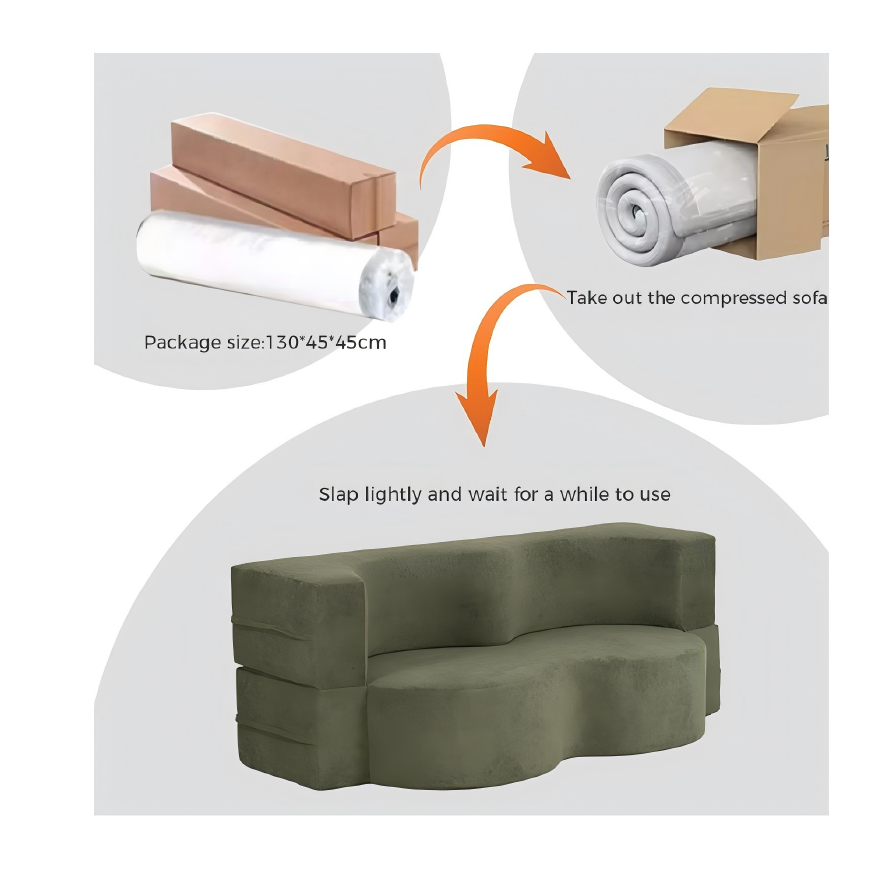
In contrast, compressed sofas utilize high-density, high-rebound foam and articulated internal frames. Once vacuum-sealed, they fit into standardized, courier-friendly cartons that stack seamlessly.
A Head-to-Head Comparison
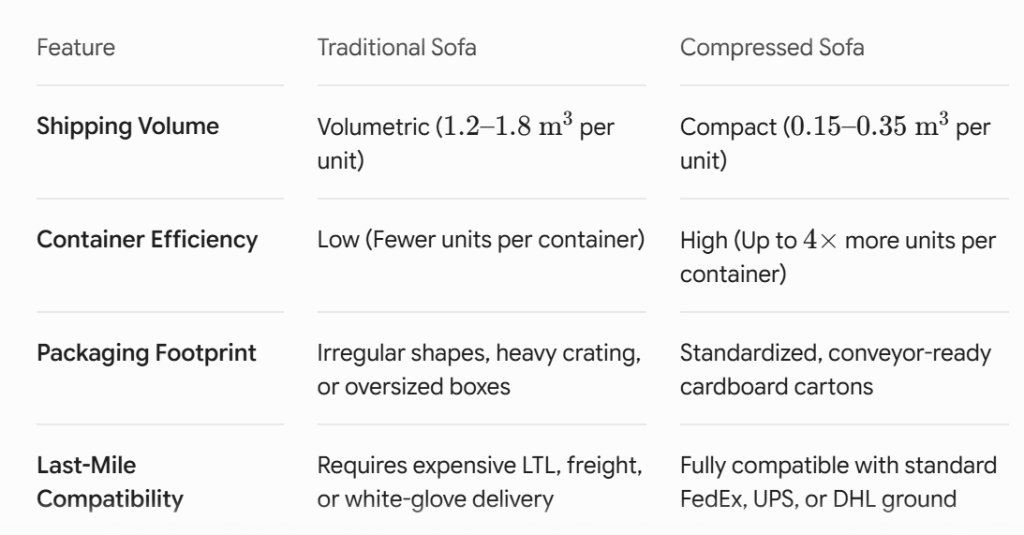
By slashing the volume per unit down to as low as $0.15 \text{ m}^3$, importers can drastically lower their per-unit ocean freight costs, freeing up significant profit margins.
Part 2: Why choose China to import Compressed Sofa
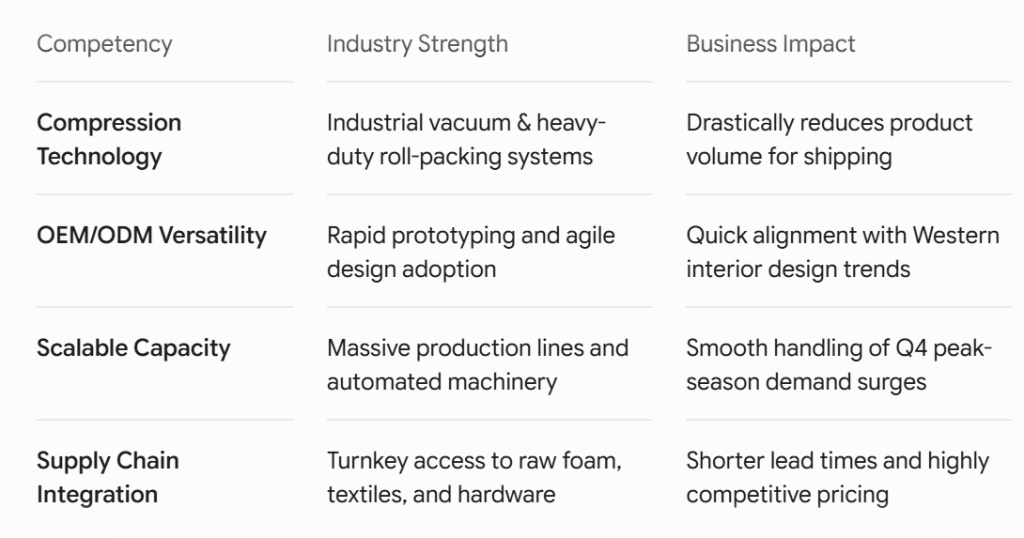
China boasts a mature and comprehensive supply chain, giving it unique scale and speed advantages in compressed furniture manufacturing.
This highly regionalized industrial clustering enables raw materials, components, and logistics to collaborate with hyper-efficiency. Among these hubs, Foshan, Guangdong is the “Furniture Capital of the World,” leading in premium upholstery, cutting-edge design, and world-class exports. Meanwhile, NingBo,Zhejiang has rapidly emerged as a specialist in high-volume foam formulation and e-commerce compressed furniture.
Furthermore, leading Chinese manufacturers invest heavily in automated precision foam-cutting and high-tonnage industrial vacuum-compression systems. These advanced engineering and packaging technologies ensure that products can withstand months of transit without losing their shape.
Key Manufacturing Advantages at a Glance
Part 3: How to Vet and Choose a Reliable Supplier
In the compressed furniture industry, selecting a vendor based solely on the lowest Free on Board (FOB) quote is a high-risk gamble.
Factory Credentials & Social Audits
Quality Management System: ISO 9001 certification.
Social Responsibility & Ethics: Valid BSCI (Business Social Compliance Initiative) or SMETA audit reports.
Material Safety Certifications: Documentation verifying compliance with global textile and chemical safety benchmarks (e.g., CertiPUR-US or OEKO-TEX Standard 100).
The Real Cost of Cheap Manufacturing
When a factory undercuts the market, they are almost always cutting corners in two critical areas:
Foam Density: Cheap, low-density foam will collapse permanently under vacuum pressure. When your customer unboxes the product, it will fail to expand properly, leaving it wrinkled, sagging, or visibly deformed.
Substandard Box Strength: Weak cardboard boxes will burst under the intense internal expansion pressure of a vacuumed sofa during transit, exposing the delicate fabric inside to dirt and tearing.
The Professional Buyer’s Vetting Checklist
When auditing Chinese manufacturers on B2B platforms or conducting physical factory inspections, always request and verify the following credentials:
Technical & Product Specifications
Foam Density & Composition: Ensure the core consists of high-rebound polyurethane foam (ideally $30\text{–}45 \text{ kg/m}^3$) engineered to fully recover after 3 to 6 months of continuous compression.
Decompression Recovery Reports: Ask for lab-tested data demonstrating that the foam returns to $100\%$ of its original volume within 24 to 48 hours of unboxing.
Carton Drop-Test Certification: Confirm that the final packaging complies with ISTA (International Safe Transit Association) standards to withstand rigorous e-commerce sorting hubs.
Part 4: Calculating Your True Landed Cost
The factory’s FOB quotation is just the starting point of your financial model. To protect your margins, you must project the Total Landed Cost before wires are sent.

Part 5: Navigating Regulatory Compliance and Product Safety
Furniture compliance regulations continue to tighten in major consumer markets. Failing to verify these certifications prior to export can result in costly customs delays, severe financial penalties, or forced product recalls.
Common requirements include:
REACH regulation
EN 1021 flammability testing
OEKO-TEX standards
TB 117 compliance
Importers should also verify:
Foam safety
SVHC restrictions
Label accuracy
Country of origin labeling
For more details ,please check in another blog .
Part 6: 5 Critical Pitfalls to Avoid When Sourcing
To protect your bottom line, steer clear of these common operational mistakes:
Chasing the Lowest Unit Price: Saving $10 at the factory often triggers thousands of dollars in customer returns due to sunken, low-density foam.
Overlooking Outer Box Dimensions: Ensure your box dimensions sit within the standard parcel thresholds of domestic couriers (like FedEx or UPS Ground) to avoid punishing “oversized item” delivery surcharges.
Skipping Pre-Shipment Inspections: Always retain an independent, third-party inspection agency (such as QIMA or SGS) to perform random before the container doors are locked.
Leaving Goods Compressed for Too Long: Coordinate production closely with your shipping schedule. If a vacuum-packed sofa sits inside a hot shipping container for more than 4 to 6 months, the foam cells may suffer permanent structural failure.
Vague Country-of-Origin Labeling: Ensure clear, compliant “Made in China” markings are permanently affixed to both the product tags and the master shipping cartons to prevent delays at customs checkpoints.

Conclusion: Scale Your Business with Smart Logistics
Importing compressed sofas from China offers a massive competitive edge for modern furniture brands, e-commerce retailers, and brick-and-mortar stores alike. By switching from legacy, bulk-shipping methods to streamlined, vacuum-packed logistics, you can slash warehousing overhead, optimize your last-mile delivery, and quickly scale your product lines.
The path to profitability lies in building a resilient, compliant supply chain. By prioritizing high-density foam, securing robust packaging, and partnering with verified manufacturers, your brand can confidently tap into the massive potential of the compressed furniture market.