
Executive Summary & The B2B Business Case for Developmental Play Equipment
Global consumer demand in the juvenile product sector has undergone a fundamental shift. Overseas retailers, brand owners, and educational distributors are increasingly prioritizing active movement play gear over passive toys. Modern parents and early childhood educators actively seek products that promote physical health while accelerating neurological milestone achievement.
Leading global health authorities—including the World Health Organization (WHO), the American Academy of Pediatrics (AAP), and the Centers for Disease Control and Prevention (CDC)—emphasize that early childhood brain development is deeply coupled with physical movement. Gross motor activities stimulate neurogenesis, enhance synaptic plasticity, and build critical neural pathways through sensory integration (vestibular, proprioceptive, and tactile systems).
This comprehensive sourcing guide provides international B2B buyers with a science-backed framework to select active play inventory for three core developmental stages: Infancy (0–1 Year), Toddlerhood (1–3 Years), and Preschool (3–6 Years).
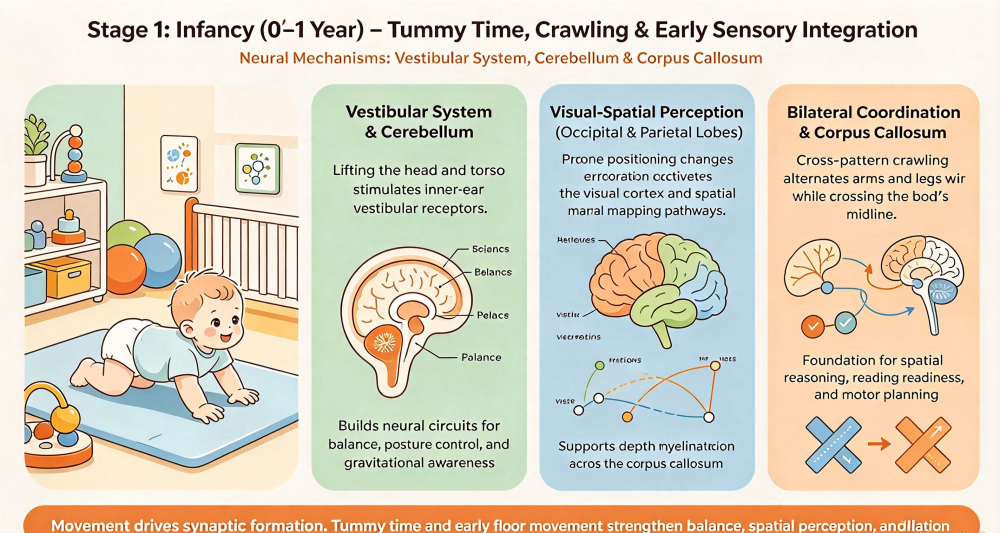
Stage 1: Infancy (0–1 Year) – Tummy Time, Crawling & Early Sensory Integration
Neural Mechanisms: Vestibular System, Cerebellum & Corpus Callosum
During the first year of life, an infant’s brain undergoes rapid synaptic formation. Placing babies in prone positions (tummy time) and encouraging early floor movement directly fuels neurological milestones:
Vestibular System & Cerebellum: Lifting the head and maneuvering the torso stimulates inner-ear vestibular receptors. This builds neural circuits in the cerebellum responsible for balance, posture control, and gravitational awareness.
Visual-Spatial Perception (Occipital & Parietal Lobes): Prone positioning alters an infant’s visual perspective. Horizontal exploration activates visual cortex (occipital lobe) and spatial mapping (parietal lobe) pathways, fostering depth perception and hand-eye coordination.
Bilateral Coordination & Corpus Callosum: Cross-pattern crawling requires alternating arms and legs while crossing the body’s midline. This movement accelerates myelination across the corpus callosum—the nerve bundle linking the left and right cerebral hemispheres—establishing a foundation for future spatial reasoning, reading readiness, and motor planning.
B2B Product Selection & Sourcing Criteria
Critical Sourcing Categories
When sourcing for the 0–1 age bracket, importers should focus on soft, non-toxic, and easy-to-clean materials that provide stable support for tummy time and early crawling:
Waterproof Play Mats & Tummy Time Pads: Sourcing a durable, non-toxic waterproof toddler play pad or infant activity mat provides a hygienic foundation for daily prone play, protecting infants from floor impacts while simplifying cleanup for parents and daycares.
Soft Crawling Blocks & Tunnels: Sourcing indoor soft climbing blocks for babies encourages early obstacle navigation, body-weight shifting, and cross-lateral limb coordination in a safe, impact-absorbing environment.
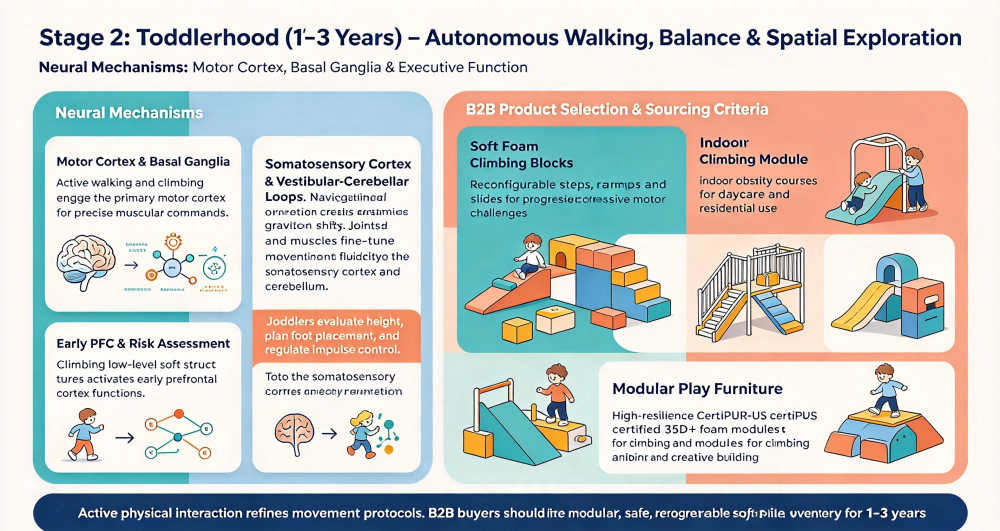
Stage 2: Toddlerhood (1–3 Years) – Autonomous Walking, Balance & Spatial Exploration
Neural Mechanisms: Motor Cortex, Basal Ganglia & Executive Function
As toddlers transition from supported walking to autonomous running and climbing, their brains require intense physical interaction to refine movement protocols:
Motor Cortex & Basal Ganglia: Replacing prolonged stroller containment with active walking and climbing engages the primary motor cortex to send precise muscular commands. The basal ganglia fine-tunes movement fluidity and procedural motor memory.
Somatosensory Cortex & Vestibular-Cerebellar Loops: Navigating inclined soft foam block configurations creates dynamic shifts in gravity. Proprioceptors in joints and muscles feed real-time spatial orientation data into the somatosensory cortex and cerebellum.
Early Prefrontal Cortex (PFC) & Risk Assessment: Climbing low-level soft structures forces toddlers to evaluate height, plan foot placement, and regulate impulse control, activating early PFC executive functions.
B2B Product Selection & Sourcing Criteria
Must-Have Inventory Categories
Retail buyers catering to the 1–3 age category should target modular, adaptable indoor soft play gear:
Soft Foam Climbing Blocks: B2B buyers should stock soft play climbing blocks for toddlers and structured foam climbing toys for toddlers that can be reconfigured into steps, ramps, and slides to support progressive motor challenges.
Indoor Climbing Modules: Sourcing high-density toddler climbing blocks indoor solutions allows daycare centers and residential consumers to create safe, all-weather indoor obstacle courses.
Modular Play Furniture: Sourcing the best play couch for 2 year old development requires selecting high-resilience, CertiPUR-US certified 35D+ foam modules that withstand heavy climbing while supporting creative building.
Official Guidelines & Scientific Evidence
UK National Health Service (NHS) & WHO Standards: Recommend that toddlers (ages 1–2) accumulate at least 180 minutes (3 hours) of varied physical activities daily. Health authorities strongly advise restricting toddler constraint in strollers or car seats to less than 1 hour at a time, advocating for open-ended indoor and outdoor climbing play.
Vestibular Neurodevelopmental Studies (Pediatric Physical Therapy): Research shows that dynamic balancing activities stimulate the vestibular-ocular reflex (VOR), enhancing eye-tracking precision and visual fixation—skills directly tied to future reading comprehension and sustained attention span.

Stage 3: Preschool / Early Childhood (3–6 Years) – Complex Motor Skills & Executive Function
Neural Mechanisms: Prefrontal Cortex, BDNF & Frontoparietal Networks
Between ages 3 and 6, physical activity transitions from basic motor acquisition to complex, rule-based, and creative movement challenges:
Prefrontal Cortex (PFC) & Executive Function Triad: Complex obstacle navigation and cooperative building activate the three core pillars of executive function:
Inhibitory Control: Regulating bodily impulses, stopping abruptly, or adjusting direction during dynamic play.
Working Memory: Retaining spatial obstacle rules and multi-step play sequences.
Cognitive Flexibility: Modifying movement strategies when a structure shifts or a route is blocked.
Brain-Derived Neurotrophic Factor (BDNF) & Neuroplasticity: Moderate-to-vigorous physical activity (MVPA) triggers cerebral secretion of BDNF, promoting neurogenesis and synaptic strengthening within the hippocampus (the brain’s memory center) and prefrontal cortex.
Frontoparietal Network Myelination: Complex motor planning accelerates information transfer across frontoparietal neural networks, improving focus, task persistence, and classroom learning performance.
B2B Product Selection & Sourcing Criteria
High-Margin Modular Play Systems
Preschoolers require versatile, multi-piece active play equipment that merges gross motor exercise with imaginative play:
Multi-Piece Modular Play Couches: Offering a 14 piece modular play couch gives commercial clients and retail consumers maximum layout flexibility to build fortresses, balance beams, steep ramps, and jumping landing pads.
Novelty & Interactive Features: Sourcing specialized SKUs like a glow in the dark play couch adds a compelling unique selling proposition (USP) for direct-to-consumer (DTC) brands, enhancing nighttime sensory exploration and creative play.
Advanced Balance Equipment: Balance boards, wobble cushions, and modular foam obstacle tracks challenge postural stability and refine cognitive-motor integration.
Official Guidelines & Scientific Evidence
WHO (2020) & US CDC Physical Activity Guidelines: Prescribe that children aged 3–4 perform at least 180 minutes of daily physical activity, including at least 60 minutes of Moderate-to-Vigorous Physical Activity (MVPA) (e.g., jumping, climbing, running).
Neuroscience Research (MDPI Brain Sciences / Neuroscience & Biobehavioral Reviews): Systemic reviews demonstrate that physically active play involving cognitive engagement (e.g., constructing and navigating complex foam obstacle courses) produces significantly higher gains in executive function and working memory compared to repetitive, unchallenging physical exercise.
B2B Sourcing Comparison Matrix: Active Play Gear vs. Neurodevelopmental Impact
The following matrix synthesizes stage-specific product recommendations, target neural structures, developmental benefits, and official scientific citations for commercial sourcing teams: