
How Our Twin-Sample Testing Prevents High Returns on Custom Orthopedic Dog Bed Orders
For B2B pet product buyers, importers, and e-commerce brand owners, vacuum-compressed packaging is essential for lowering ocean freight and landed costs. However, compressed shipping introduces significant risks: foam failing to rebound after weeks in a container, deep fabric wrinkles, or vacuum seals leaking in transit—leading to costly customer returns and damaged brand reputations.
At our manufacturing facility, we believe sourcing a custom foam dog bed shouldn’t be a gamble. That’s why we implemented our proprietary Twin-Sample Quality Guarantee.
In this article, we’ll reveal how our real-time transit simulation catches quality flaws before mass production starts, saving our partners thousands of dollars in potential return costs.
The Hidden Risks of Sourcing Vacuum-Compressed Pet Beds Overseas
Vacuum roll-packing reduces shipping volume by up to 70%, making high-volume international transport cost-effective. However, prolonged compression creates unique manufacturing challenges:
Foam Memory Loss: Low-density or scrap-blended foam can permanently deform after 30 to 60 days under extreme vacuum pressure.
Persistent Cover Wrinkling: Heavy compression can leave permanent creases on outer covers, making a premium orthopedic foam dog bed look cheap and unappealing upon unboxing.
Packaging Expansion in Transit: If a vacuum bag has a micro-leak, the package expands inside the container or warehouse, causing unexpected dimensional freight surcharges.
To solve these pain points, we don’t just produce and ship—we simulate the exact journey your product takes to the end consumer.
The Twin-Sample Quality Guarantee: Real-Time Transit Testing
Whenever a client requests a sample for a custom large memory foam dog bed or specialty pet mat, we produce two identical units under the exact same conditions on the exact same day:
Sample A: Express-shipped directly to the buyer’s office for design and material verification.
Sample B (The Twin): Retained in our quality testing laboratory under continuous compression for 30 to 45 days.
While Sample A is in transit to you, we continuously monitor Sample B in our facility. This real-time test tracks foam recovery speed, structural integrity, and fabric condition over an extended shipping timeframe.
Case Study: Spotting Fabric Wrinkles Before Mass Production
During a recent OEM project for a custom orthopedic dog bed, we subjected the retained twin sample to a 1.5-month static compression test.
The Test Results:
Foam Resilience: Passed with 100% bounce-back. In our real-world load-bearing test using a 39 lb dog, the high-density support core showed zero sagging or structural fatigue.
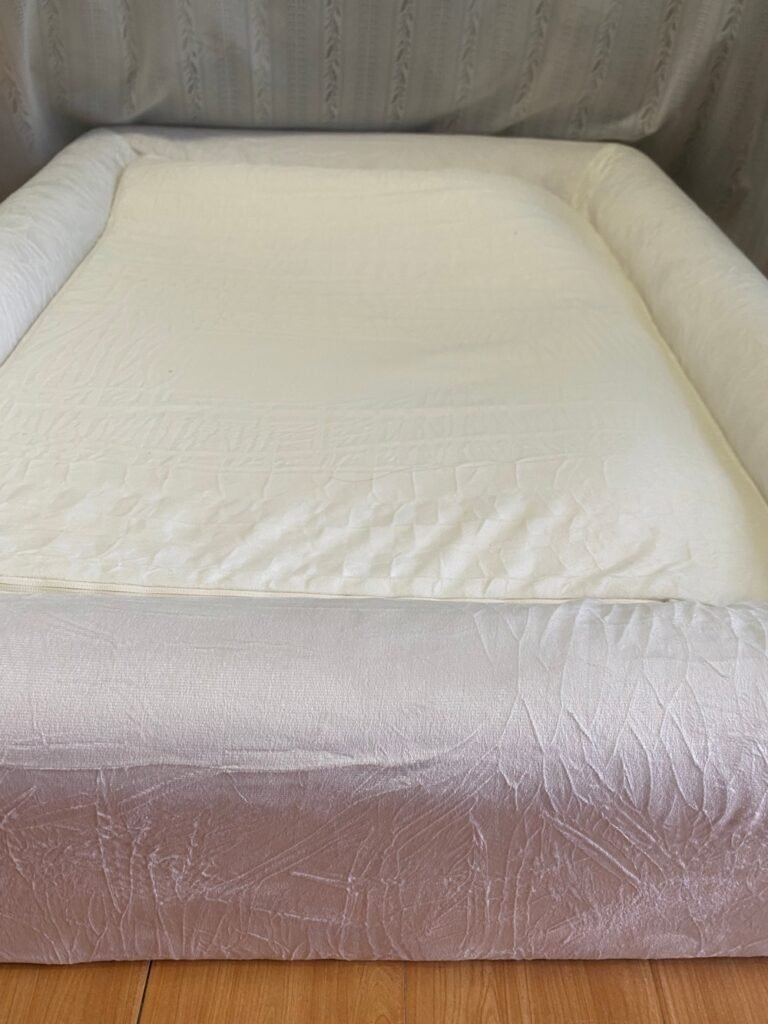
Outer Cover Inspection: Upon decompression, we spotted minor fabric wrinkles across the top panel caused by tight pre-folding under high pressure.
The Proactive Solution:
Rather than proceeding directly to mass production and risking bad product reviews for our client, we immediately flagged the issue and presented two optimization solutions:
Pattern Fine-Tuning: Slightly tightening the cover pattern to pull the fabric taut upon decompression.
Pre-Folding Optimization: Modifying the folding sequence prior to vacuum sealing to eliminate sharp crease lines.